The "Programming Tax": Why Your SMT Line is Only 70% Efficient
What is the "Programming Tax" in SMT manufacturing? The Programming Tax is the significant efficiency loss—often ...
January 23, 2026
Selected for the Canadian Technology Accelerator's Taipei 2026 Hard Tech Cohort, DaoAI lands at Computex InnoVEX Canada Pavilion this June — bringing next-gen AI AOI to the heart of global PCBA manufacturing.
Talk about AI in 2026 and nine out of ten conversations land on "AI Agents." From writing code, building slide decks, and booking flights, to customer service, research, and sales — "able to think and act on its own" is no longer novel; it's the default. But when this Agent wave hits the hardest industrial frontier — SMT production lines and PCBA inspection — things fall silent. The reason is simple:
Drop a GPT-scale model into an AOI to decide whether a component is missing? The latency won't allow it. The cloud won't allow it. And a false call certainly won't. But that doesn't mean the Agent era has nothing to say to industrial AI — quite the opposite. The real revolution of Agents isn't about how big the model is; it's about the design philosophy: goal-centric, closed-loop perceive–decide–act–reflect, and freeing humans from writing rules so they can instead set intent and give feedback.
What DaoAI has done is bring that Agent design philosophy into PCBA visual inspection. Our core isn't a large language model — it's a vision foundation model trained specifically for SMT. But the underlying workflow — automatically generating inspection regions, automatically generating inspection logic, learning from operator feedback, iterating the model — is Agent thinking from end to end.
This answer will be on display in Taipei this June.
This year, DaoAI joins the Canadian Technology Accelerator (CTA) Hard Tech Cohort alongside seven other Canadian companies at Computex InnoVEX 2026 in Taipei, stationed inside the Canada Pavilion — showing the world what industrial AI looks like when the Agent design philosophy actually reaches the production line.
The Canadian Technology Accelerator (CTA) is the flagship global accelerator program led by Global Affairs Canada, reserved for deep-tech companies with international competitiveness and built to land them inside the world's most critical industrial clusters.
Within CTA's global map, Taipei's position is unmistakably clear: one of the key hubs for ICT and hard tech — semiconductors, SMT, robotics. Taiwan has the most complete electronics manufacturing ecosystem in the world, from advanced packaging to PCBA assembly. This isn't just a production base; it's the ultimate proving ground for industrial AI — where every scenario Agent thinking should prove its worth shows up in its most demanding form.
DaoAI is the only company in this cohort with "AI visual inspection in production" as its core technology line.
Traditional AOI is a textbook rule engine: engineers manually draw inspection windows, tune parameters, and hard-code decision logic. Every new board takes 3–5 hours of work. It's the same pattern as pre-Agent software development — humans enumerate every rule exhaustively, machines only execute.
The paradigm shift Agents bring is flipping that relationship around: humans set the goal and give feedback; the AI figures out how to reach it. DaoAI AI AOI grounds this principle in the factory across four layers:
Traditional AOI engineers feed machines rules — a window for every component, a hard-coded threshold for every parameter, starting from scratch for every new board. DaoAI replaces that with giving it a goal: hand it a single golden board, and —
No CAD files. No component libraries. No AOI engineers. This is the industrial version of Agent thinking: give intent, not procedure.
What makes an Agent an Agent is the closed loop. Every board that runs through DaoAI AI AOI runs a complete one:
One of the hardest limits on general LLM Agents is that data has to go to the cloud. For EMS / OEM, that road is closed. Production data is trade-secret territory — BOM structure, defect distribution, process parameters — none of it can leave the building.
DaoAI's answer is 100% on-premise: training, inference, defect adjudication, SPC statistics — all executed inside the plant. Data never leaves the site, not for an instant. It also means the system keeps millisecond-level response in any network environment, with zero external dependencies dragging it down.
The Agent principle is autonomy — but for industrial customers, autonomy must be built on top of data sovereignty. Otherwise you've just repackaged the risk.
This is the most fundamental human–machine division of labor the Agent era has produced. On DaoAI AI AOI, modeling work that once required a senior AOI engineer can now be completed independently by a line operator after brief training. Humans pull back to setting goals and reviewing outcomes; AI takes over everything that can be automated.
The result: about USD 15,000–40,000 saved per person per year, and 60% lower total operating cost.
DaoAI's AI AOI isn't a standalone machine. It's an intelligent inspection platform that embeds deep into a customer's existing MES / SPC stack:
In one line: from small EMS shops to high-throughput giants, everyone benefits from AI-driven programming efficiency.
During Computex InnoVEX, we'll be meeting in depth with Taiwan's and the world's semiconductor, EMS, and foundry leaders.
Live board validation · distributor evaluation · deep technical dive — book it all into InnoVEX week.
What is the "Programming Tax" in SMT manufacturing? The Programming Tax is the significant efficiency loss—often ...
January 23, 2026
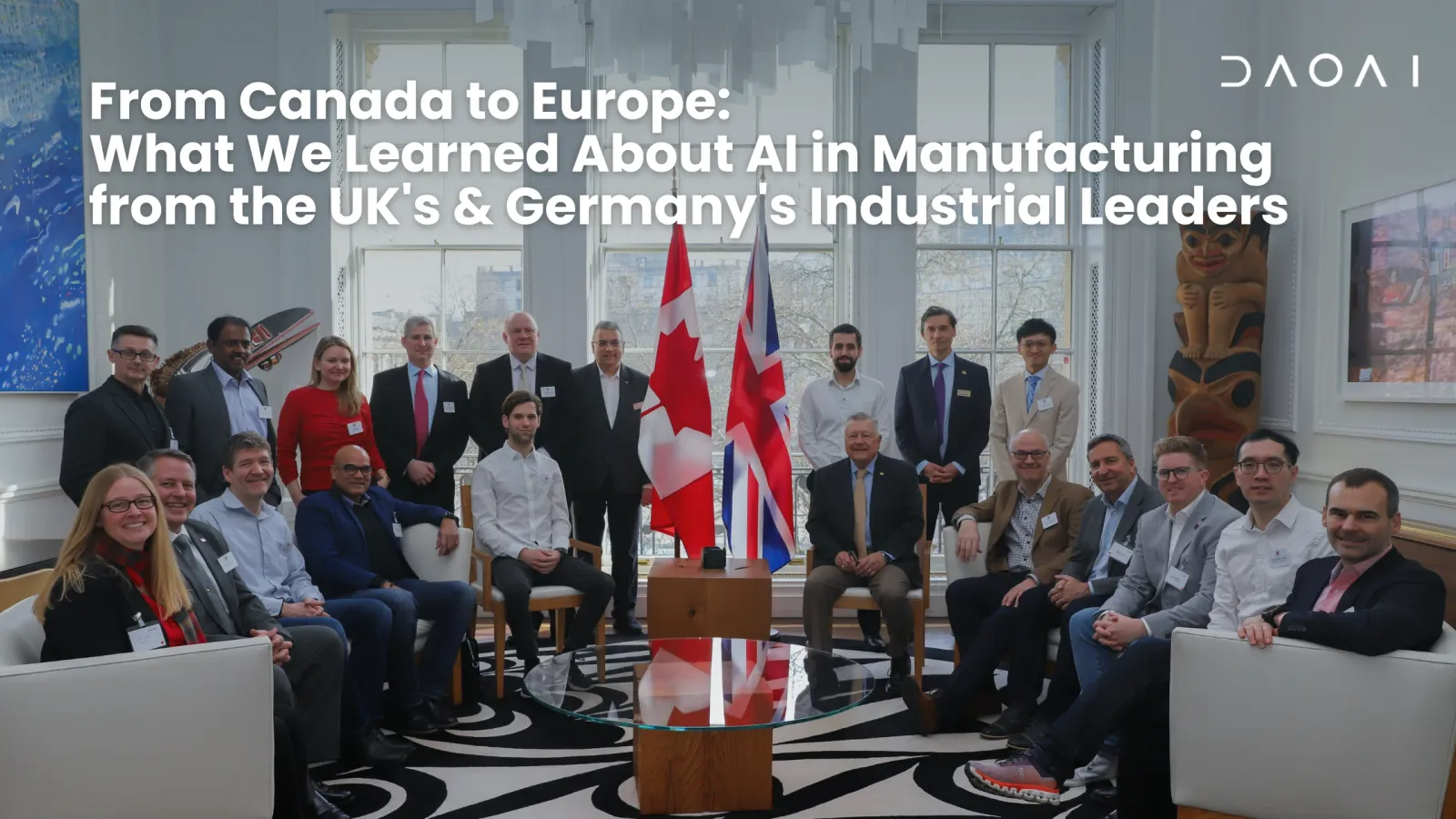
Our journey across the UK and Germany unlocked unexpected insights, powerful partnerships, and a front-row view into ...
May 13, 2025
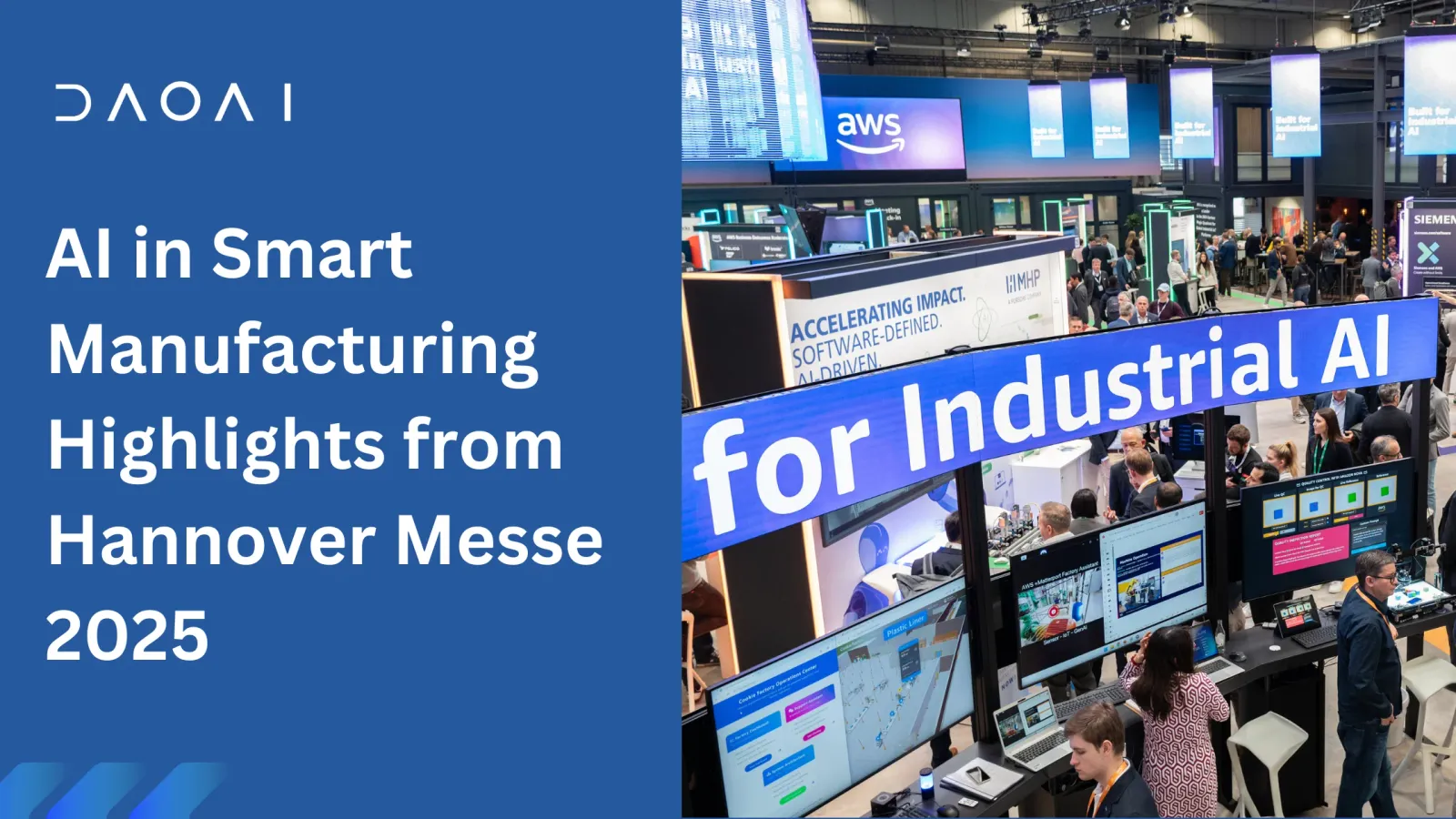
Global Stage for Smart Manufacturing Innovation This year, the DaoAI team attended Hannover Messe 2025 in Germany, ...
April 16, 2025
AI inspection insights, product news, and industry analysis. Once a month, no noise.