
Open Solder Joints: How AOI Detects Visible Defects
See how AOI identifies visible open solder joints, where fixed color thresholds struggle, and how a pretrained 2D model handles common and special cases.
September 17, 2026
Which AOI false calls you can tune away, which ones live below the threshold layer, and how to tell the difference before you buy another round of tuning hours.
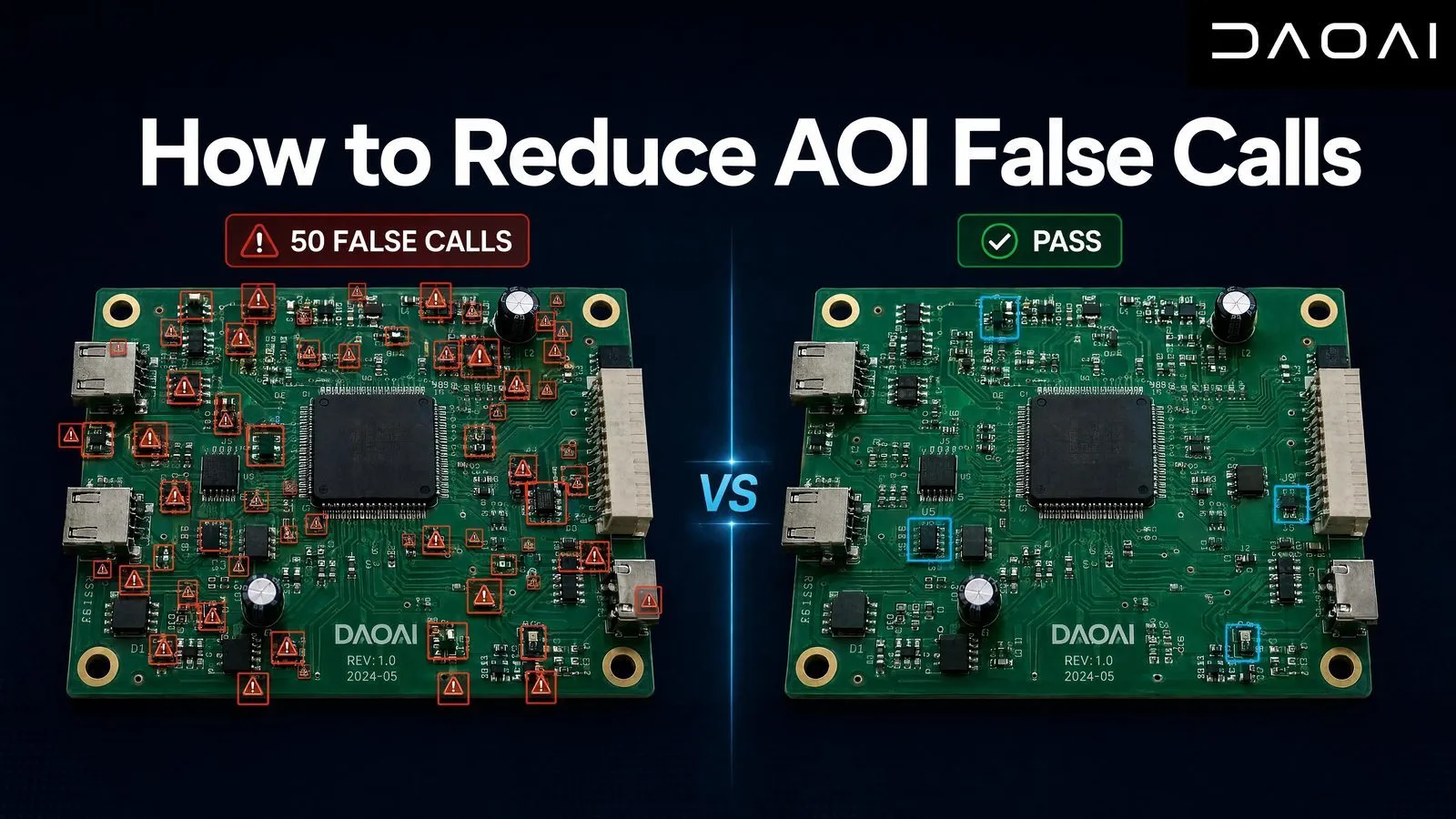
To reduce AOI false calls, fix causes in this order: confirm the golden sample is actually good, bring lighting and optics back to spec, clean up the component library, then re-tune thresholds window by window against IPC-A-610. Loosening limits across the board is not a fix. It trades false calls for escapes. And if false calls climb back after every changeover or new component lot, the wall you keep hitting is the rule-based algorithm itself, which is an architecture problem rather than a tuning problem.
A false call (also written false positive, or overkill) is the AOI flagging a good board as defective. Each one sends a board to a human for a second look. A machine that cries wolf fifty times a shift wastes labor. It also teaches operators to stop believing it, and that is the expensive part. This article covers where false calls come from, what they cost, what you can realistically fix on a traditional AOI, and what changes when the inspection logic is AI instead of rules.
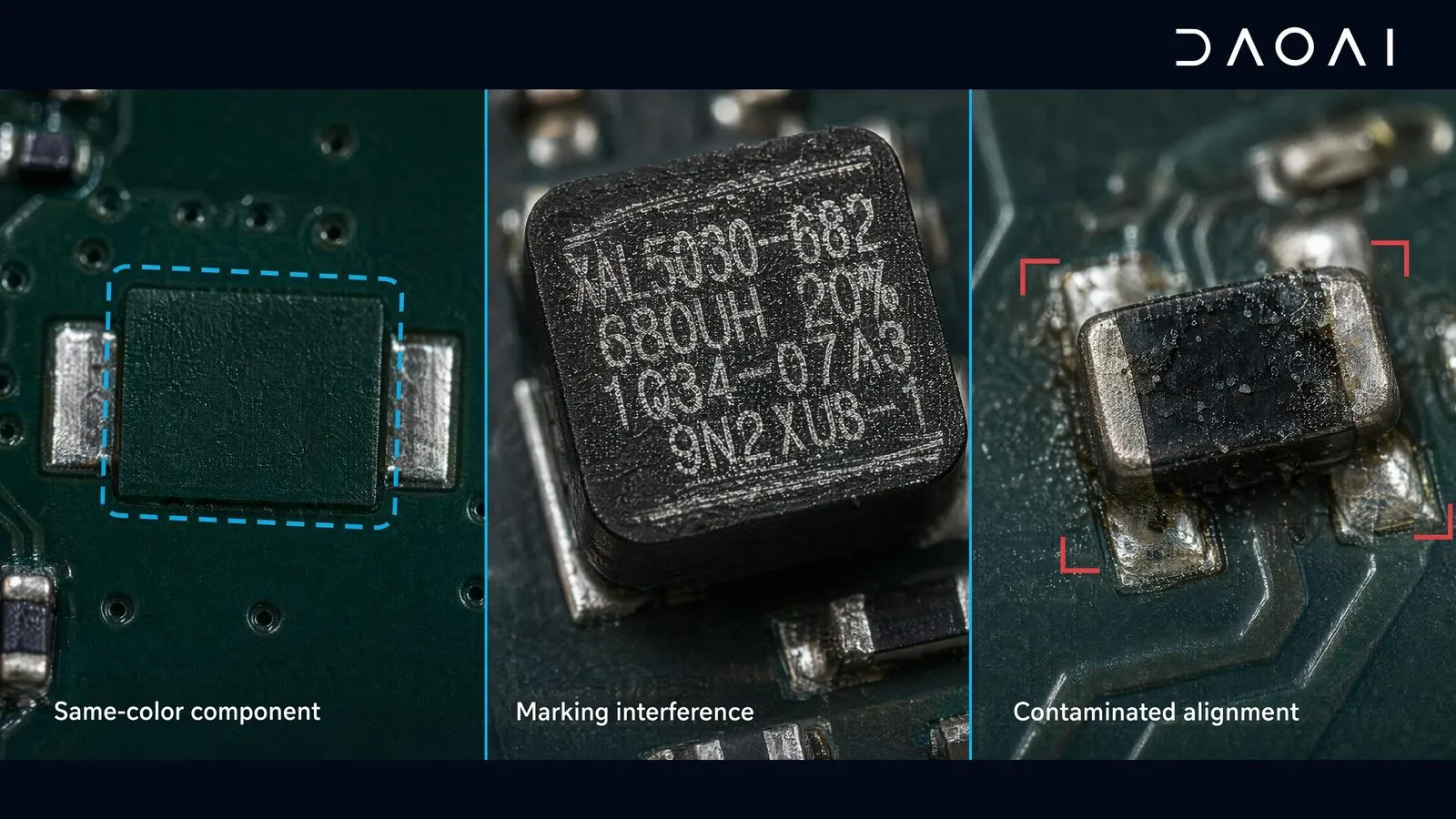
AOI false calls come from inspection rules that cannot absorb normal process variation. The usual sources are thresholds set tighter than the acceptance criteria require, lighting drift, component lot changes, and board warpage. A few component types go further and break color-based algorithms outright: bodies that match the laminate color, plus the dense surface markings on chip inductors and crystal oscillators. Those deserve special attention, because no amount of threshold work fixes them.
Most false-call discussions stop at "thresholds too tight." Fair, but that is the shallow end. The full list looks like this:
Run a Pareto on your false-call reasons. If the last three dominate, you have algorithm-class problems, and tuning will not reach them.
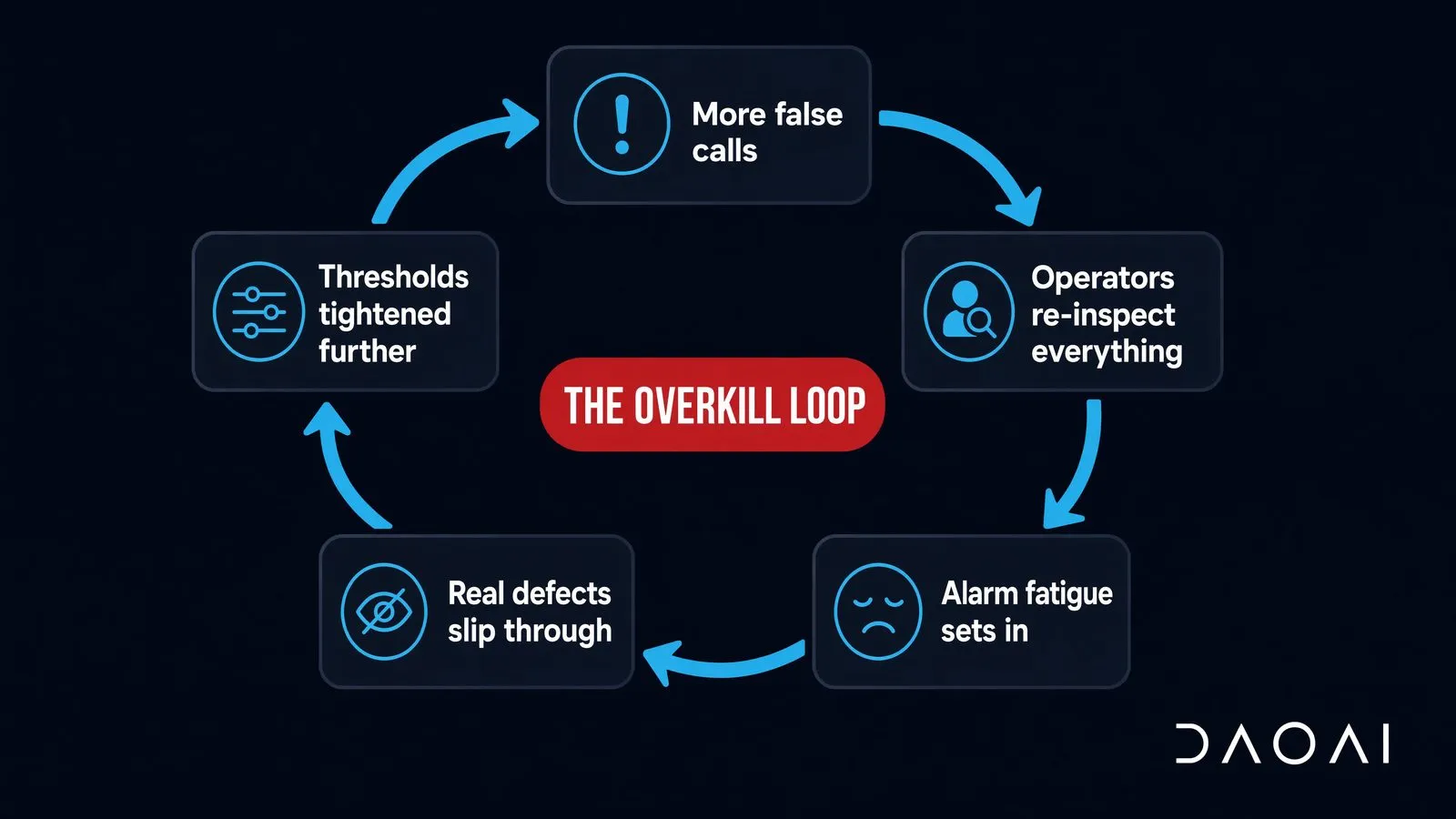
False calls cost money in three layers: re-inspection labor (an operator re-judging every flagged board), line stoppage while boards queue at the verify station, and operator desensitization, which is the least visible layer and the most expensive one. When most alarms are false, humans start rubber-stamping, and real defects ride through on credibility the machine has already spent. DaoAI puts re-inspection and stoppage costs at roughly USD 15,000 to 40,000 per operator per year (DaoAI-reported).
The third layer deserves a closer look because it inverts the purpose of inspection. An AOI drowning in overkill stops saving labor and starts producing escapes of its own, since the human verify step it leans on has gone numb. Quality teams then tighten thresholds to catch what slipped, which produces more false calls, which deepens the numbness. That loop is why "we'll just re-inspect the flags" never stays cheap.
There is a slower cost too. Once false calls dominate, engineers stop trusting anything the AOI reports. Defect trends and SPC charts built on its output turn into noise, and the machine ends up ignored. An ignored inspection system is a very expensive way to not inspect boards.
On a traditional AOI, reduce false calls by fixing the measurement system before touching thresholds. Re-verify the golden sample, restore lighting to spec, and update the component library for the lots actually on the line. Then re-tune limits window by window against IPC-A-610 criteria, starting from a Pareto of the worst offenders, and check repeatability so you know the remaining variation belongs to the process and not to the machine.
Done in that order, this recovers real ground:
None of this is permanent, though. Every changeover, new product, and new component lot hands some of the work back. High-mix shops feel it most, because the tuning debt comes due at every NPI.
AI reduces false calls by judging components in feature space instead of pixel space. A trained vision model extracts shape, structure, texture, and spatial context, then scores anomalies against what a good board actually looks like, rather than comparing raw pixels against fixed rules. That makes the judgment tolerant of lighting drift, cosmetic lot variation, and board warpage, which are exactly the variations behind most rule-based false calls (DaoAI-reported; validate on your own boards).
Mechanism by mechanism, mapped to the root causes above:
| Root cause | Traditional mitigation | AI mechanism (DaoAI-reported) |
|---|---|---|
| Lighting/optical drift | Re-calibrate, re-tune regularly | Feature-space inference; model output does not track raw RGB shifts |
| Lot-to-lot component variation | Update library per lot | Features generalize across cosmetic variation, no per-lot re-teach |
| Board warpage / position tolerance | Widen windows, accepting escape risk | High tolerance for positional variation in feature extraction |
| Same-color components | Often unsolvable with RGB rules | Multi-dimensional feature embeddings beyond RGB separate part from laminate |
| Inductor/oscillator markings | Mask regions or live with the noise | Multi-feature discriminator separates marking signatures from defect signals |
| Contaminated alignment | Manual review | AI localization stays accurate despite surface contamination |
| Over-tight thresholds | Periodic manual re-tuning | Thresholds generated from the golden board, then refined by feedback |
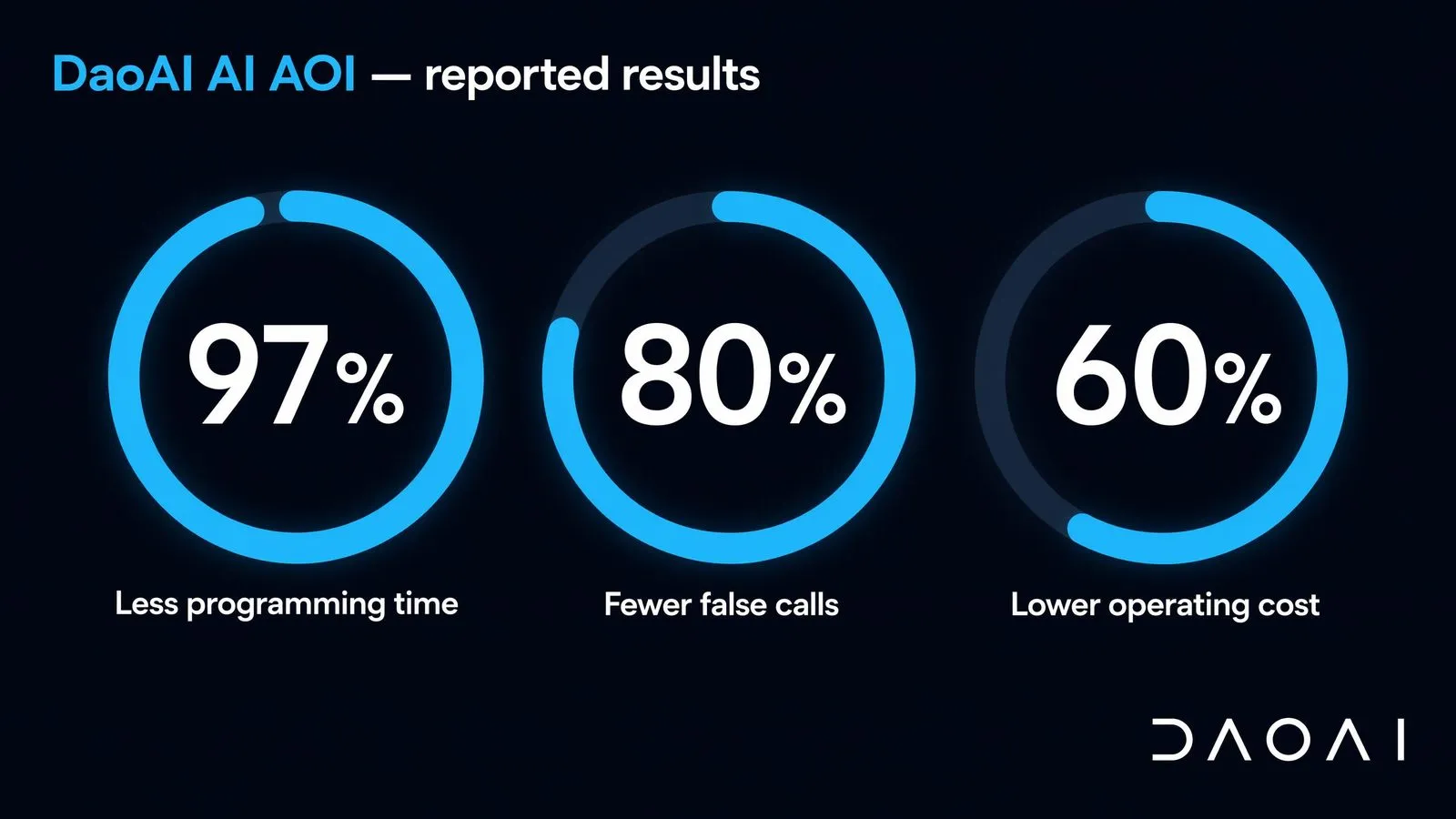
The second structural difference is the feedback loop. On DaoAI's system, when an operator marks a flagged image as a false call, that judgment feeds back into the model and the parameters update. Each line's own production becomes its training data, so the false-call rate trends down with use instead of drifting up. (The golden-board workflow behind this is covered in AOI programming without CAD files.) DaoAI reports up to 80% fewer false calls than traditional AOI, alongside detection accuracy of 98% or higher, from production deployments including a major Asian electronics manufacturer (DaoAI-reported figures; confirm them on your own boards during a demo).
The acceptance standard itself does not move. Accept and reject criteria still map to IPC-A-610. What the model changes is how reliably the system can tell "different but acceptable" from "defective." For the detection side of the same architecture, see how single-image AI detection handles defect variety.
Tuning is no longer enough when false-call work has turned into a permanent engineering function instead of a commissioning task. The signals: every changeover needs thresholds re-tuned, false calls rebound after each component lot or vendor change, re-inspection has become a staffed station rather than an exception, and escapes are showing up while overkill stays high. At that point the constraint is the rule-based architecture, and more tuning buys you weeks.
A practical way to frame the decision. Tuning is still the right tool if your product mix is stable, NPIs are rare, the library has an owner, and false calls actually dropped after the maintenance sequence above. Stable high-volume lines with disciplined programs run traditional AOI well. That is an honest fit, and the fuller comparison covers it.
Architecture is the constraint if false-call burden scales with your mix. Every NPI restarts the tuning debt. Second-source parts break pattern matches. Your Pareto is dominated by same-color parts, marked inductors and oscillators, or lighting drift, and those causes live below the threshold layer where tuning cannot reach. A simple test: if you are paying engineers to buy back the same false-call reduction every month, the fix is rented, not owned. An architecture that learns from feedback buys it once.
There is no single benchmark worth trusting, because shops measure on different bases: per component (PPM), per board, or as a share of total calls. Mix, board complexity, and threshold philosophy move the number by orders of magnitude. The useful discipline is to pick one basis, baseline each line, and watch the trend. A rising false-call trend on a stable process means the program is drifting, not the product.
A false call flags a good board as defective. An escape passes a real defect. On rule-based systems the two trade against each other: tighten thresholds and false calls rise, loosen them and escapes rise. High false-call rates also cause escapes indirectly, by desensitizing the operators doing re-inspection.
Blanket loosening will. That is buying quiet with escapes. Loosen only windows proven over-tight against IPC-A-610 criteria, and only after reference, lighting, and library issues are fixed. If a window cannot be made quiet without crossing the standard, the limit you have found is the algorithm's ability to absorb variation, not your tuning skill.
Less than most engineers expect. DaoAI's system starts from a single golden board. The model arrives pre-trained on more than one million real production images and adapts to your board from that one sample, then keeps improving from operator feedback during normal production (DaoAI-reported). There is no data-collection project standing between installation and first inspection.
No system honestly promises zero, because inspection always balances sensitivity against noise. The realistic goal is a false-call burden low enough that re-inspection is an exception rather than a station, while escapes stay at zero. Judge any vendor claim, including ours, by trend data on your own boards.
If your false-call Pareto is dominated by the left column of that table, more tuning hours will not move it. DaoAI's P Series applies feature-space inspection with operator-feedback learning across offline (P1/P2) and inline (P3/P3D) configurations.
See how AOI identifies visible open solder joints, where fixed color thresholds struggle, and how a pretrained 2D model handles common and special cases.
September 17, 2026
Vendor ROI calculators decide the assumptions for you. Here is the whole model: eight cost lines, the formulas for false-call and escape savings, and two worked scenarios including one that does not pay.
August 25, 2026
Vendor accuracy numbers mean nothing until you reproduce them on your own boards. Six boards to bring, five things to measure, and what a passing result looks like.
August 11, 2026
AI inspection insights, product news, and industry analysis. Once a month, no noise.